AI-designed coronavirus vaccine clears first human safety trial
The University of Cambridge and its spinout DIOSynVax reported on Thursday that pEVAC-PS, a candidate vaccine whose active component was built entirely by AI, cleared its first safety trial in 39 healthy volunteers. The same shot raised antibodies against SARS-CoV-2, the original SARS virus, and bat coronaviruses that have never infected a human. If it holds up at larger scale, it's a credible shot at vaccinating against the next pandemic before the pandemic starts.
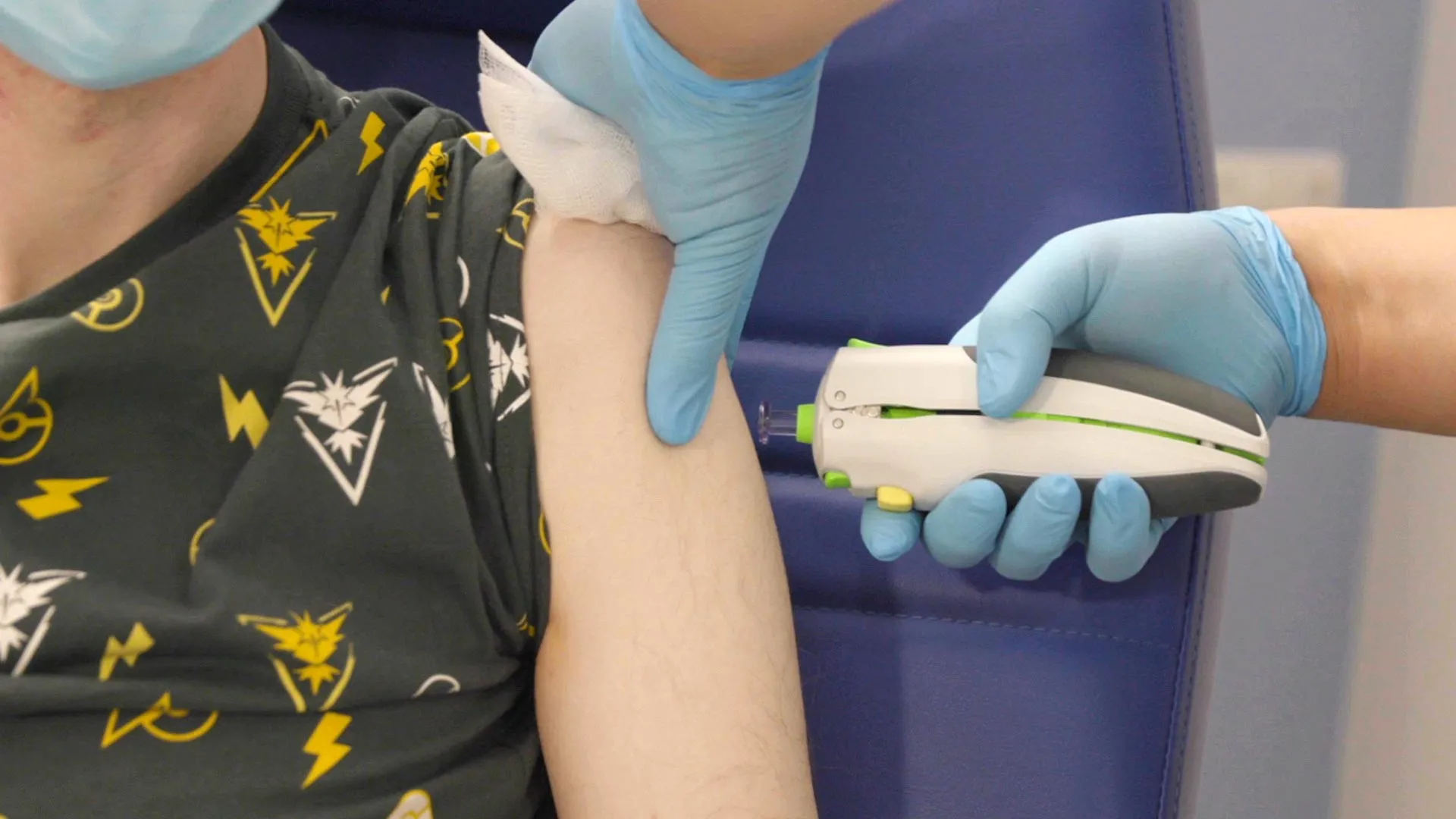
What the trial showed
The Phase 1 study enrolled 39 healthy volunteers aged 18 to 50 at NIHR clinical research facilities in Southampton and Cambridge. The results, published Thursday in the Journal of Infection, report no significant adverse events. More importantly, immune-response assays detected antibodies binding to multiple Sarbecoviruses, the subgenus of coronaviruses that includes SARS-CoV-1, SARS-CoV-2, and a swarm of related viruses still circulating in horseshoe bats.
The delivery is unusual too. The vaccine is a DNA construct fired into the arm by a microfluidic jet, with no needle involved. Chief investigator Saul Faust at the University of Southampton called the older one-strain-at-a-time approach "a dog chasing its tail." The needle-free piece is operationally significant: storage and cold-chain logistics get simpler, and mass campaigns no longer bottleneck on the supply of trained injectors.
How AI designed the "super-antigen"
Standard vaccines train your immune system on a single virus protein, usually the spike from one strain. pEVAC-PS instead targets a synthetic "super-antigen" that doesn't match any one virus. The DIOSynVax team fed a machine-learning system every published Sarbecovirus genome and asked it to find the protein structure that maximizes immune cross-reactivity across the whole family — the regions the viruses can't mutate without breaking themselves.
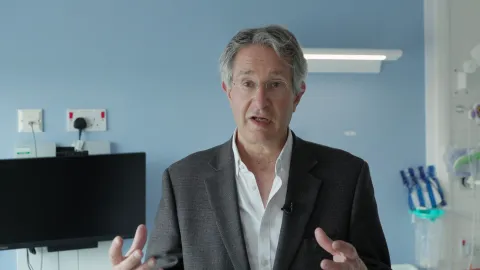
Lead researcher Jonathan Heeney of Cambridge's Lab of Viral Zoonotics put it plainly: "We've converted vaccine development from being reactive to being future proof." That's the bet. The design captures conserved regions deep enough in the viral architecture that future mutations don't escape them. The trial doesn't prove that yet; it shows the candidate is safe and provokes the broad immune response the model predicted.
Why it matters
A working pan-Sarbecovirus vaccine would let public-health systems pre-stockpile a single product against an entire viral family before the next zoonotic spillover. For comparison, the COVID-19 response burned roughly 11 months between SARS-CoV-2's genome being sequenced in January 2020 and the first Pfizer doses going into arms in December. A pre-validated platform shot collapses that timeline toward zero, which is the whole reason Innovate UK, the British government's R&D agency and the primary funder here, is writing checks.
The skeptical read: this is a Phase 1 study of 39 people designed to detect dose-limiting toxicity and basic immunogenicity, not efficacy. Antibody binding in a lab assay is not protection against infection in the wild, and the history of universal-flu and HIV vaccine programs is littered with platforms that produced gorgeous lab data and failed in challenge trials. Computational design also carries a credibility tax: the field has a recent habit of announcing AI-designed proteins that work in vitro and crumble in vivo.
What to watch
The next signal is Phase 2 dose-finding data, which will need a more demographically diverse cohort and a real neutralization readout rather than just antibody binding. Beyond that, whether DIOSynVax can push the same super-antigen design into other viral families (influenza, henipaviruses, Ebola) will decide if "AI-designed universal vaccine" is a product category or a single-pathogen story.
Sources
- New 'universal vaccine' technology could protect us from future virus outbreaks (University of Cambridge)
- AI-designed universal coronavirus vaccine passes first human trial (ScienceDaily)
- New 'universal vaccine' technology could protect from future virus outbreaks (NIHR)
- Computer-designed universal vaccine shows early human trial success (Interesting Engineering)
- A phase I, needle-free, dose-escalation clinical trial of pEVAC-PS (Journal of Infection)