A PhD student found the Rosetta Stone for radio space's weirdest signal
For the last few years, radio astronomers have collected a handful of bizarre objects that pulse every several minutes to an hour — far too slowly to be conventional pulsars and far too regular to be random bursts. On June 1, Nature Astronomy published a paper led by University of Sydney PhD student Kovi Rose that pins one of these "long-period transients" (LPTs) to a concrete system: a white dwarf siphoning matter off a small red dwarf companion. It's the first LPT with an unambiguous identification, and the authors are calling it a "Rosetta stone" for the rest of the class.
What the team actually found
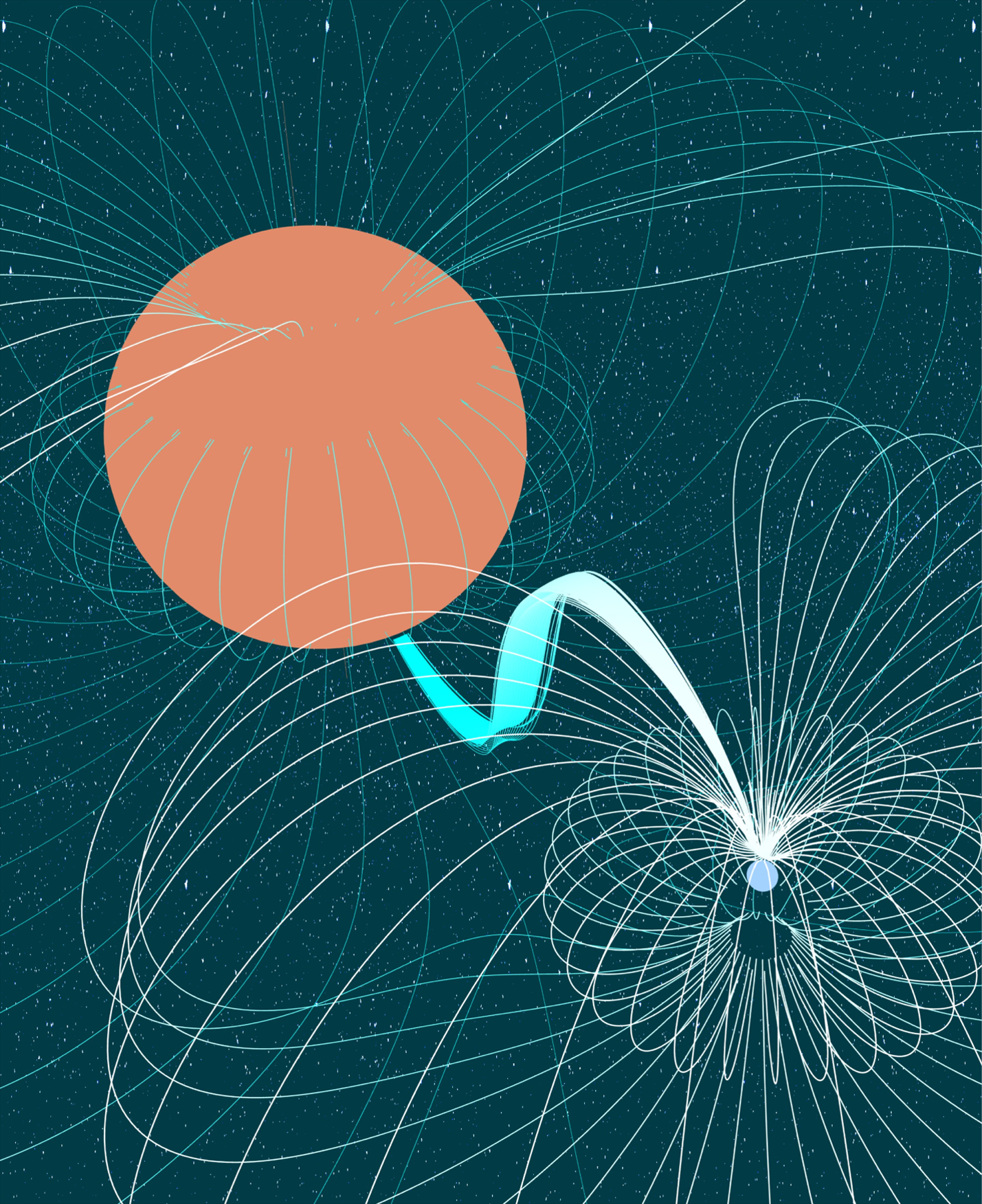
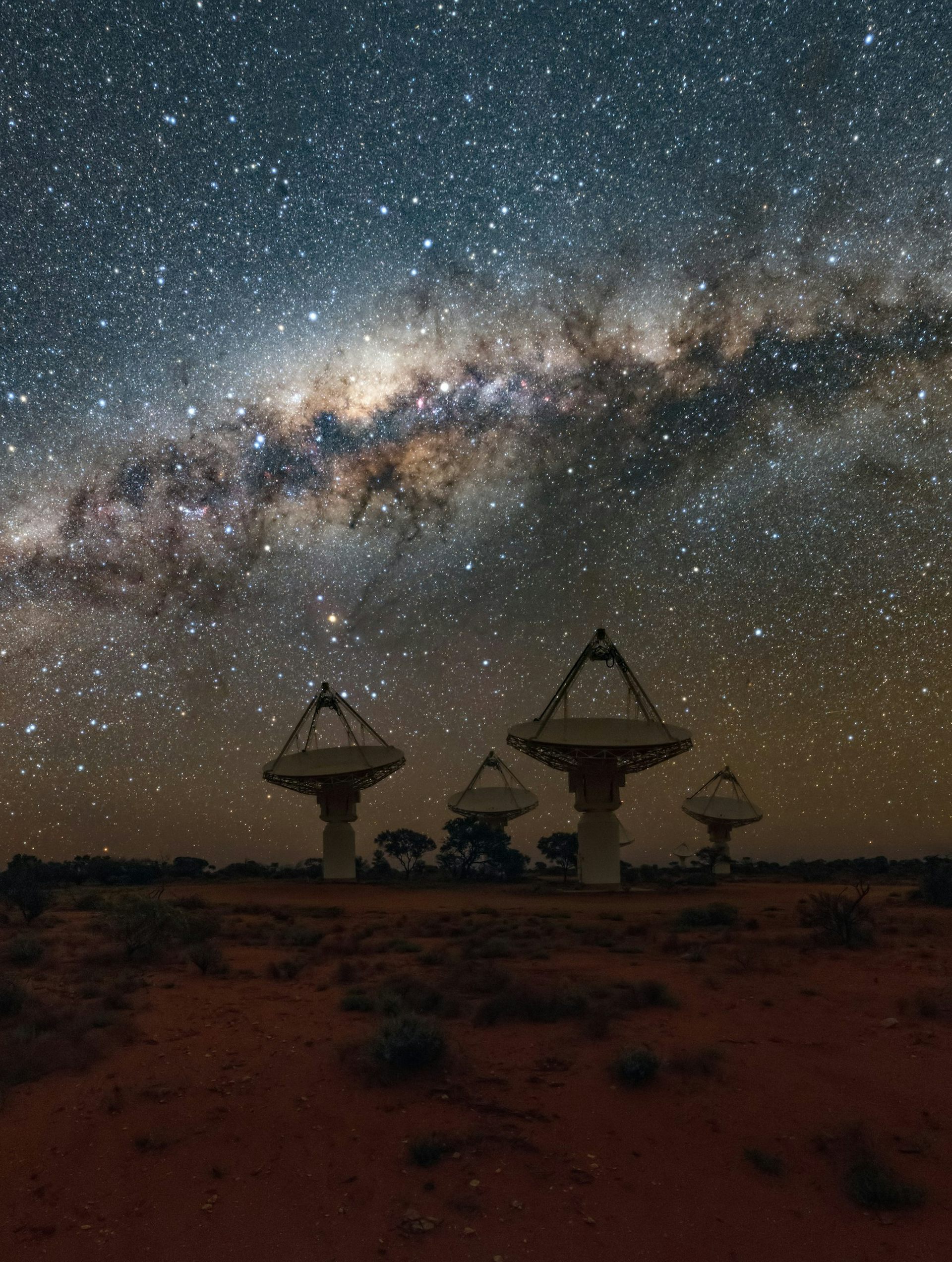
The source, designated ASKAP J1745−5051, was spotted with CSIRO's ASKAP radio telescope in Western Australia and then chased down with the SOAR optical telescope in Chile. The binary completes a full orbit just over an hour, with radio and X-ray pulses repeating every 1.4 hours. SOAR's Goodman spectrograph picked up the tell-tale emission lines of a cataclysmic variable — astronomy-speak for a binary where one star is actively dumping gas onto a white-dwarf partner. The white dwarf weighs roughly one solar mass; the red dwarf clocks in at about one tenth of that.
Magnetic fields do the rest. As stripped material spirals onto the white dwarf, the two stars' magnetic fields lock together and snap, accelerating electrons to relativistic speeds. Those electrons emit the coherent radio bursts astronomers had been picking up since 2022 but couldn't trace to anything visible.
Why it matters
Until this paper, the leading theory for LPTs was that they were ultra-long-period magnetars — neutron stars with monstrous magnetic fields, but spinning thousands of times slower than the millisecond pulsars textbooks describe. That story always had a gap: magnetar physics doesn't cleanly explain why these objects would settle into such tidy multi-minute rhythms. The white-dwarf binary explanation does, because the rhythm is just the orbit.
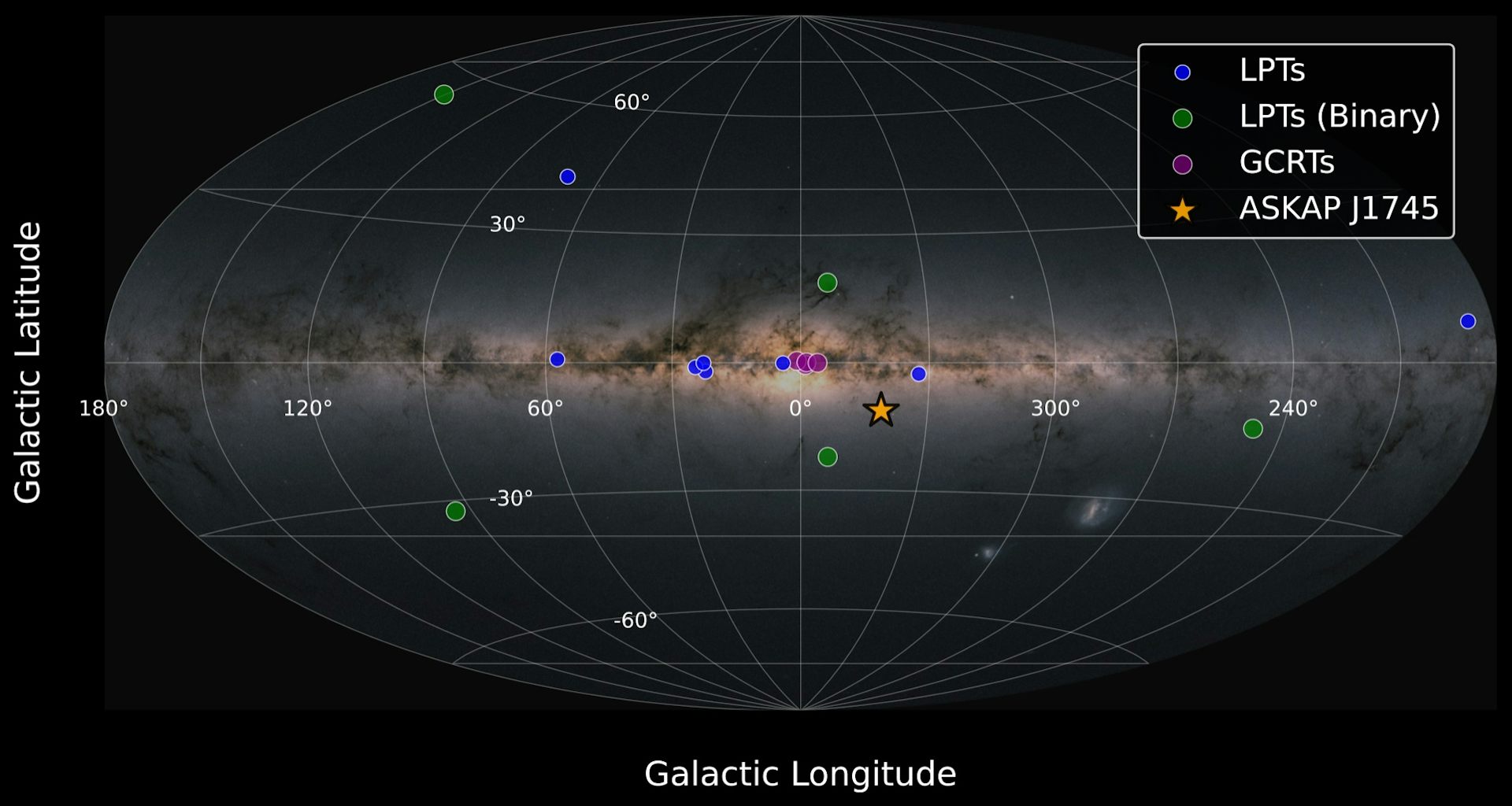
That doesn't kill the magnetar hypothesis for the whole class. There are about a dozen known LPTs, and the new paper places ASKAP J1745−5051 in a sub-group ("LPTs (Binary)") alongside two earlier suspects. The other half of the population still has no optical counterpart and could yet turn out to be neutron stars. But the field now has at least one calibration point — a system where every parameter is measured, not modeled — to test predictions against.
For engineers building the next generation of radio surveys, the result is also a small vindication of the wide-field, fast-cadence strategy ASKAP was designed for. The telescope was looking at a different patch of sky and stumbled into the source as a slow blinker; a narrow-field instrument tuned to known pulsar frequencies would have walked past it.
The skeptical read
Two caveats. First, one Rosetta stone doesn't translate every language: the optically dark LPTs may still be a different beast. Second, the cataclysmic-variable population is already huge — thousands are known — and almost none of them pulse radio waves like this. Something about ASKAP J1745−5051's geometry or magnetic configuration is unusual, and the paper is cautious about claiming it's representative until more counterparts turn up.
What to watch
The same group is already cross-matching the ASKAP transient catalog against optical surveys. The next public data drop from the Vera Rubin Observatory later this year should give them millions of new variable-star candidates to filter. Expect a second LPT-with-a-face announcement within twelve months — and an argument, almost certainly, about whether magnetars belong in the picture at all.
Sources
- Periodic radio and X-ray emission from an accreting white dwarf binary — Nature Astronomy
- Student astronomer discovers 'Rosetta stone' for mysterious cosmic signals — CSIRO
- Mysterious signals keep coming from space. We have found their 'Rosetta stone' — The Conversation
- UNC-Chapel Hill astronomers help crack cosmic radio mystery — UNC News