Two LHCb anomalies push the Standard Model in the same direction
LHCb keeps finding the same kind of crack. Two measurements at CERN's beauty-physics experiment — one accepted for publication in Physical Review Letters this spring, the other presented at a CERN seminar last week — both disagree with the Standard Model, and both do so in the same direction. Neither result has crossed the five-sigma "discovery" threshold. But the picture is getting harder to wave away.
What the two measurements actually say
The first result is about electroweak penguin decays — rare transformations in which a B meson decays into a kaon, a pion, and two muons. LHCb sifted through roughly 650 billion B-meson decays recorded between 2011 and 2018 and measured the angular distribution and branching fractions of this channel. The numbers come in at four standard deviations from the Standard Model prediction, accepted for publication in Physical Review Letters. In plain English: if the Standard Model is right, the chance of seeing data this off by accident is about 1 in 16,000. CMS — LHCb's sister experiment on the same accelerator — saw a similar pull in the same channel last year, at lower significance.
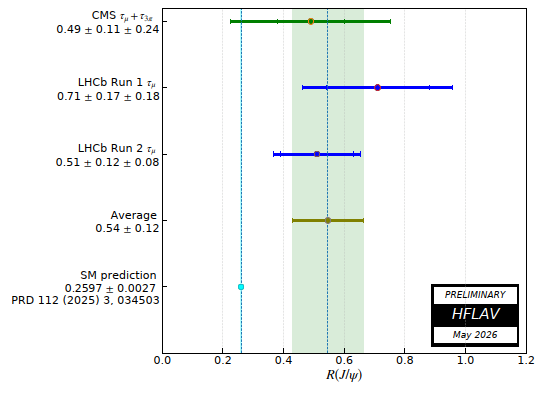
The second result, presented at a CERN seminar on May 19 by Emily Jiang of the University of Maryland, looks at a different channel: Bc+ → J/ψ τν versus Bc+ → J/ψ μν. The ratio R(J/ψ) — how often the heavy tau lepton appears in the final state, relative to the lighter muon — should be 0.2597 ± 0.0027 in the Standard Model. LHCb's Run 2 measurement comes in at 0.51 ± 0.12 (stat) ± 0.08 (syst), about 1.8σ high. Folded together with earlier LHCb and CMS measurements, the world average is R(J/ψ) = 0.54 ± 0.12, sitting 2.4σ above the prediction.
Why the two together are interesting
The penguin-decay tension lives in a process driven by virtual quantum loops; R(J/ψ) is a tree-level decay involving the third-generation tau lepton. Different physics, different theoretical machinery. But both push in the direction of something coupling more strongly to the third generation of quarks and leptons than the Standard Model allows.
That pattern is already visible in the longstanding R(D) and R(D*) anomalies, which sit at a combined 3.8σ above prediction. The Standard Model treats all three generations of leptons identically except for their masses. If the third generation is being treated differently in real data, the model is incomplete.
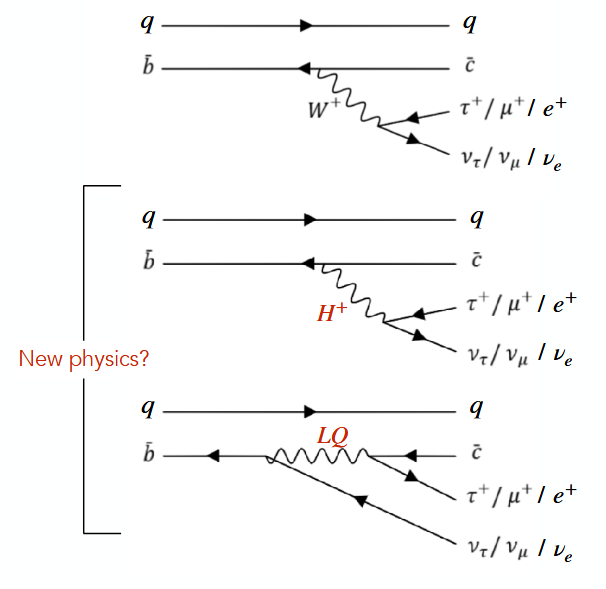
The leading candidate explanations are leptoquarks — hypothetical particles that couple quarks and leptons directly — or a charged Higgs boson beyond the single Higgs in the Standard Model. Both would generate exactly the generation-dependent shift the data are hinting at. Neither has been produced directly in any collider.
Why it matters
The Standard Model has shrugged off every claimed crack for fifty years, including a previous round of B-physics anomalies that quietly softened as data improved. The strongest counter-argument is exactly that history: 4σ is not 5σ, and R(J/ψ) at 2.4σ is well within the range of effects that have evaporated before.
What is different this time is the dataset on the way. LHCb has already recorded three times more B mesons since 2018 than the entire sample used in the PRL paper, and the HL-LHC upgrade in the 2030s will accumulate roughly fifteen times more still. Either the tension collapses with more data, or one of these channels crosses 5σ. There is no third option that takes another decade.
What to watch
The next milestone is LHCb's full Run 3 reanalysis of the B0 → K0 μ+μ− channel, expected in 2026–2027. A measurement at the same central value with the larger dataset would push the significance past 5σ on its own. Belle II's independent R(D) and R(D) updates are due on a similar timeline. If both experiments tighten and the central values hold, the question stops being "is there new physics" and starts being "what is it."
Sources
- LHCb finds new hints of possible Standard Model deviations (CERN)
- Lepton Flavor Universality Tests Using Bc+ Decays at LHCb (LHCb Outreach, May 19 2026)
- Our Large Hadron Collider results hint at undiscovered physics — William Barter & Mark Smith, The Conversation
- Comprehensive analysis of the B0 → K*0 μ+μ− decay (Physical Review Letters)
- Large Hadron Collider detects strange particle behavior that could rewrite physics (ScienceDaily)