Micron breaks $1 trillion on a bet the memory cycle is over
Micron Technology briefly crossed a $1 trillion market capitalization on Tuesday, the first memory-only chipmaker ever to do so. Shares jumped 18% after UBS tripled its price target to $1,625 from $535, the most aggressive call on the stock from any major bank this cycle. Micron is now up 208% year-to-date.
The UBS call
UBS's case rests on one claim: the memory business is no longer cyclical. Hyperscalers — Microsoft, Meta, Amazon, Google, Oracle — are signing long-term agreements that lock in volumes and partially fix prices on DRAM and HBM, the kind of contracts the memory industry has not seen in its 40-year history. The bank projects Micron will generate more than $400 billion in free cash flow between 2027 and 2029, and argues there is "no reason why MU should trade a whole lot differently than NVDA in terms of P/E."
That gap is enormous today. Micron trades at 8.42x forward earnings; the S&P 500 sits at 21.1x and the Nasdaq 100 at 24.66x. If UBS is right that the market will simply apply a "more normal multiple" — its words — to a now-structurally-different earnings profile, the math gets to $1,625 on its own.
Why this is more than a meme rally
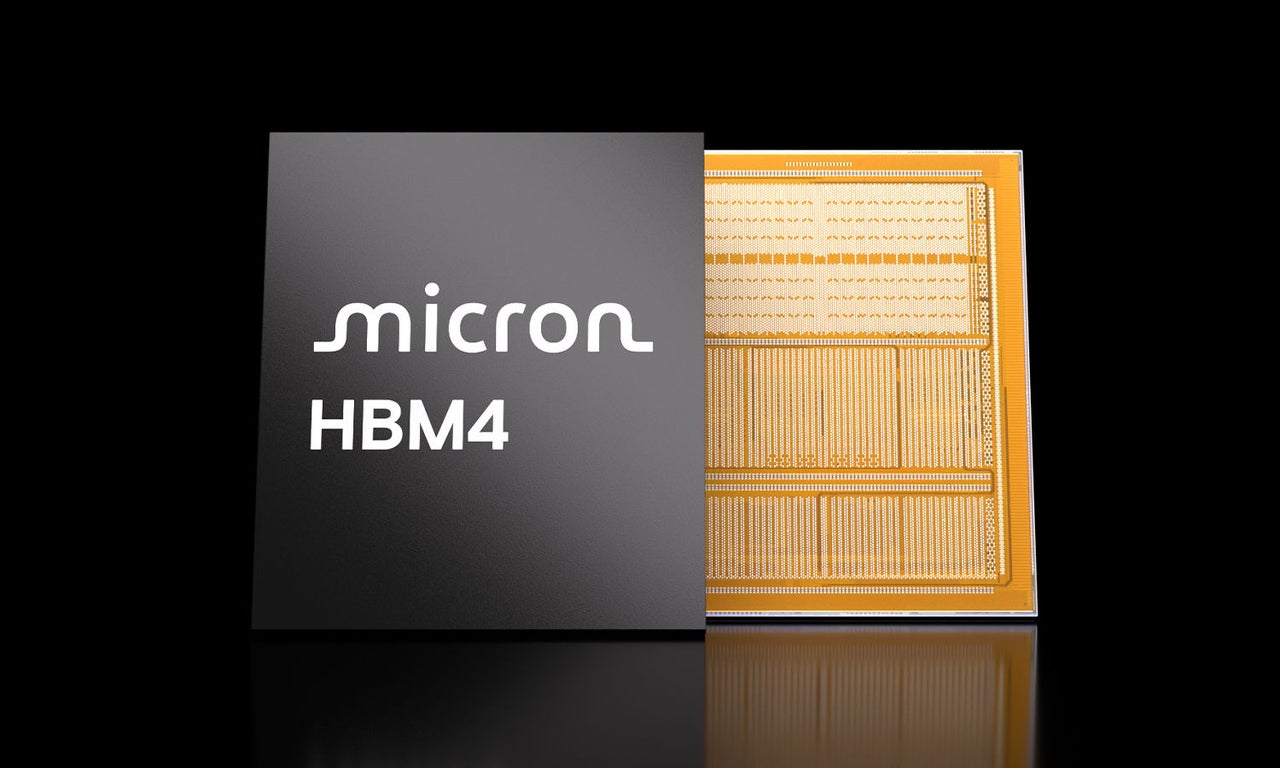
Memory's bull case has never been about Micron itself — it has been about who is buying. HBM, the stacked DRAM that sits next to every AI accelerator, is the bottleneck Nvidia's customers cannot route around. Micron's HBM4 delivers more than 2.8 TB/s of bandwidth per stack — a 2.3x jump from HBM3E — and is designed into Nvidia's Vera Rubin platform shipping later this year. The company has already sold out its entire calendar 2026 HBM supply at locked-in prices, and hiked FY26 capex to roughly $20 billion from a prior plan of $18 billion to support the ramp.
That is the part of the thesis that has actually changed. Memory used to be a commodity priced spot to spot, with cycles measured in quarters. If a meaningful portion of supply moves to multi-year contracts because hyperscalers will trade pricing flexibility for guaranteed allocation, the earnings volatility that justified Micron's perma-discount goes away.
The counter
SK Hynix still owns the HBM market — roughly 53–62% share, depending on whose data you read — and was first to mass production on both HBM3E and HBM4. Samsung is ramping, too. Micron sits in third place at around 20% share. UBS's thesis works for Micron only if hyperscalers genuinely want a diversified supplier base rather than the cheapest bidder, and if memory pricing holds when AI capex eventually moderates.

Why it matters
A re-rated Micron pulls the rest of the memory complex up with it. SK Hynix and Samsung's memory divisions trade on the same cyclicality assumptions; if UBS's thesis holds for Micron, it holds for them too. For hyperscalers, the implication is uglier: locking in supply means accepting that the memory bill is no longer something they can negotiate down each quarter. Memory just became a fixed cost of AI training, on par with energy.
President Trump praised Micron at a New York rally — "Micron, boy Micron's great, they're investing hundreds of billions" — but the noise is incidental. The substance is the structural call UBS is making, and whether the rest of the Street follows. At $1,625, Micron would be the seventh-biggest US company, ahead of Tesla, Meta, and Berkshire Hathaway.
What to watch
Micron's fiscal Q3 2026 earnings, due in late June, are the next concrete test. The numbers that matter: HBM revenue mix, signed-volume disclosure for fiscal 2027, and whether management confirms or hedges the "fully booked" framing through 2027. If the LTA story shows up in actual reported segment economics, the re-rating accelerates. If it does not, UBS's call is a single-bank outlier on the verge of being lonely.
Sources
- Micron hits $1 trillion market cap for the first time as stock surges 18% (CNBC)
- Micron tops $1 trillion market cap as UBS sees company becoming an AI giant (Yahoo Finance)
- Micron closes in on $1 trillion market value as UBS triples share price target (Reuters via Investing.com)
- Micron HBM4 product page