Webb Finds Methane on Interstellar Comet, Pointing to Alien Chemistry
The James Webb Space Telescope has directly detected methane gas on comet 3I/ATLAS, the third interstellar object ever spotted passing through our solar system. The result, published today in The Astrophysical Journal Letters, is the first time anyone has measured methane on a visitor from another star — and the abundance does not match anything seen in comets born around our Sun.
What Webb actually saw
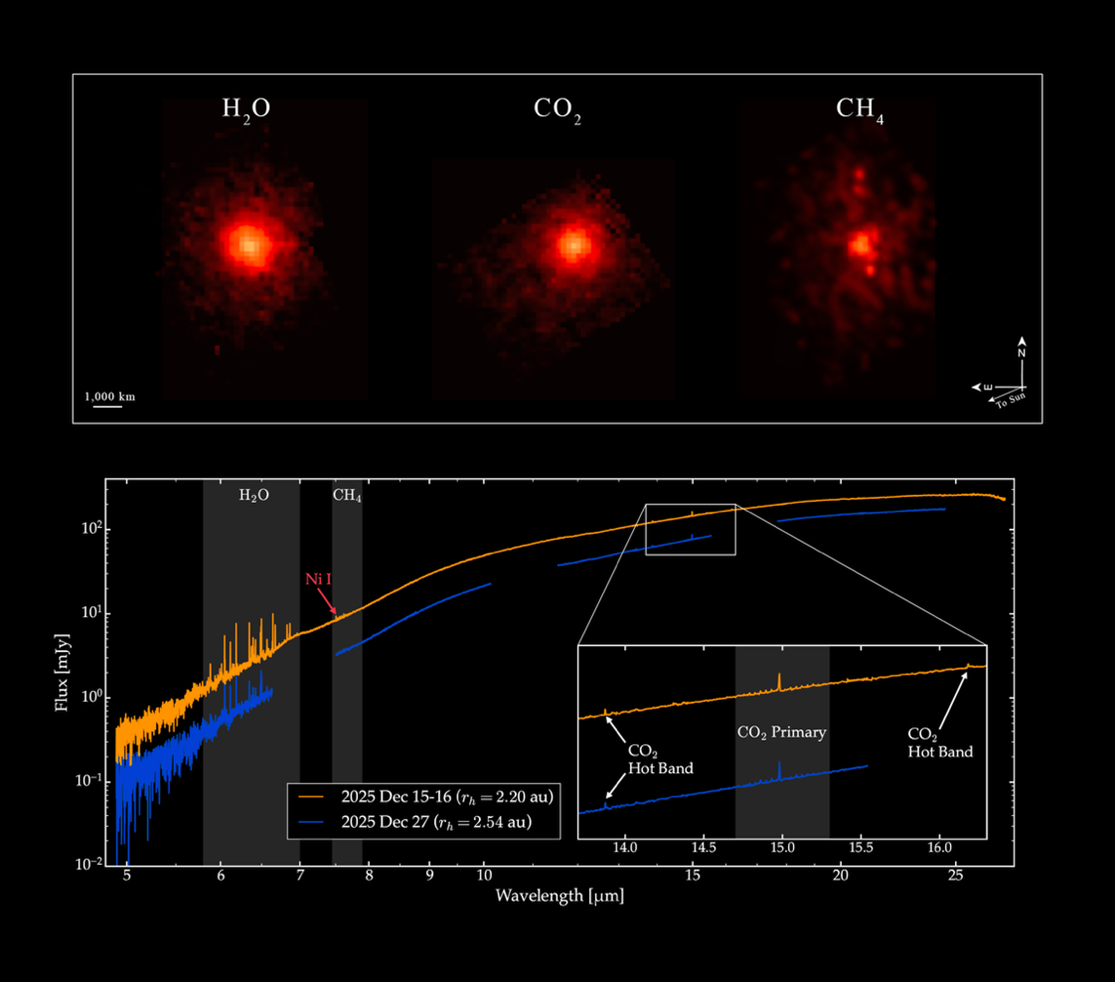
3I/ATLAS was discovered on July 1, 2025 by the NASA-funded ATLAS survey telescope in Chile. Its orbit is hyperbolic — it is not bound to the Sun, which means it formed somewhere else and is just passing through. After it rounded the Sun in late October and started heading back into interstellar space, the team pointed Webb's Mid-Infrared Instrument (MIRI) at it twice: on December 15–16, 2025, when the comet was 205 million miles from the Sun, and again on December 27, at 236 million miles.
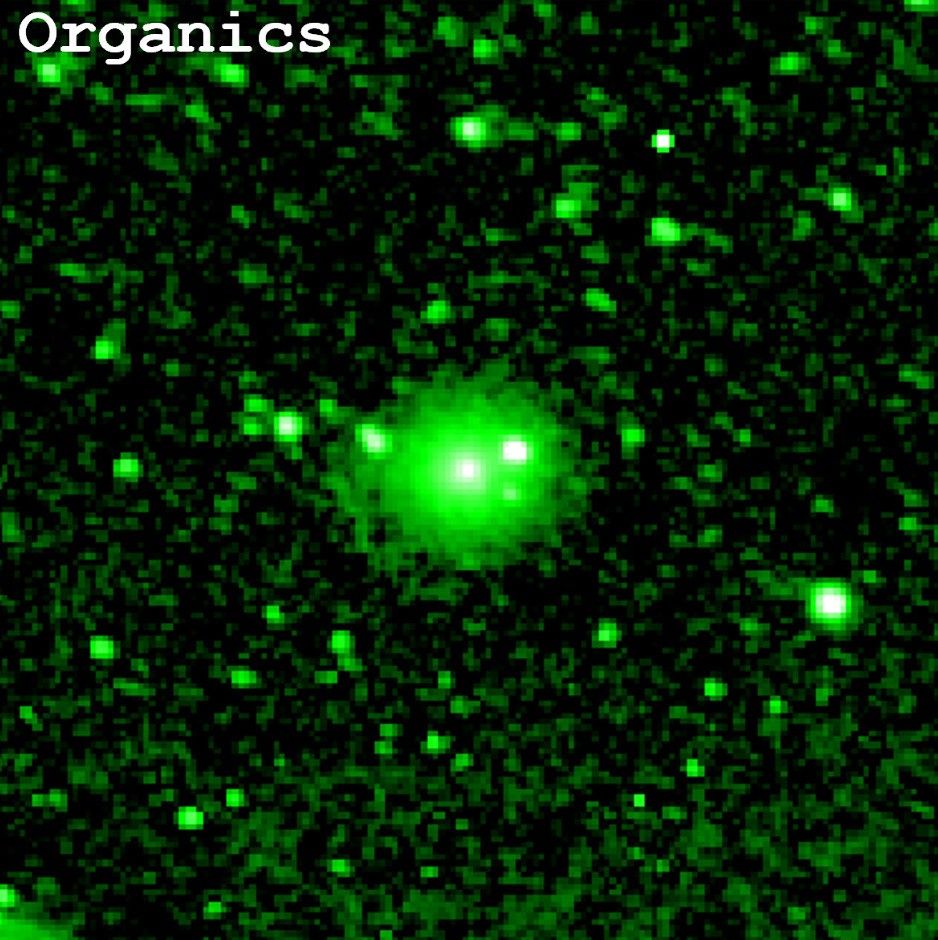
MIRI doesn't take a single picture — it captures a spectrum, a fingerprint of which infrared wavelengths the gas around the comet absorbs and emits. In that fingerprint the team led by Matthew Belyakov (Caltech) and Ian Wong (STScI) found water, carbon dioxide, and — for the first time on an interstellar object — a clear methane (CH4) signal. They also picked up atomic nickel, the same exotic emission that ESO's Very Large Telescope had already flagged in 3I/ATLAS earlier in 2025.
The methane line itself is not the headline. The ratio is. The amount of methane relative to water is, in NASA's words, "surprisingly high, with few similar analogs in our own solar system." Most solar-system comets are water-dominated; methane is a trace volatile because it boils off easily at any temperature warmer than the deep outer Oort Cloud. To preserve it in this proportion, 3I/ATLAS had to form and spend most of its life in a place colder than almost anything our own protoplanetary disk produced.
Why it matters
This is a sample-return mission without the spacecraft. We have direct chemistry on ice that formed around another star — something interstellar probes will not be able to do for decades. The methane-to-water and CO2-to-water ratios are diagnostic of formation temperature, so the numbers feed straight into models of how planet-forming disks chemically segregate volatiles. The early reading: 3I/ATLAS's home disk built its comets in a deeper freeze than ours.
It also sharpens the contrast between the three confirmed interstellar visitors. 1I/'Oumuamua in 2017 was a bizarrely shaped object that vented almost no gas. 2I/Borisov in 2019 was carbon-monoxide-rich and looked more like an over-cooked outer-system comet. 3I/ATLAS is now the methane-and-CO2 case. Each one is telling a different chemical story, which means "interstellar comet" is not a single category — it's a sampling of how varied other star systems' nurseries are.
There is the obvious caveat to name. Webb measured the gas escaping the comet, not the ice locked inside it; the ratios in the coma are an indirect proxy for the bulk composition, filtered through which species sublimate more easily at the comet's current temperature. The paper accounts for this, but it's the load-bearing assumption, and a different observation of the same object could revise the absolute numbers.
What to watch
3I/ATLAS is now heading back out of the solar system and dimming fast; the December MIRI dataset will likely be the most detailed look anyone gets at it. Two follow-ons matter. First, the same team has unpublished JWST near-infrared spectra that should constrain the isotopic ratios — the D/H ratio in particular is a much sharper probe of formation temperature than the methane-to-water ratio. Second, the Vera Rubin Observatory's LSST begins full survey operations this year and is expected to find a 3I-class interstellar object roughly every six months. The next one will not catch the community as flat-footed as 'Oumuamua did.
Sources